
Why Interpretation, Not Data, Is the Real Bottleneck in Decision-Making
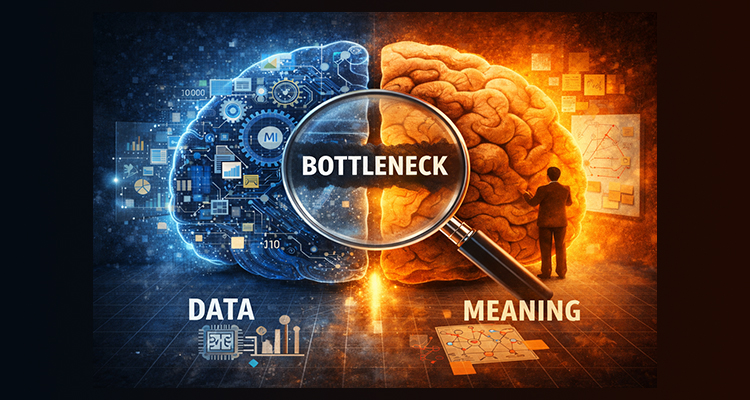
Organizations have more data than ever.
They also seem no more confident in their decisions.
That tension isn’t accidental.
For years, the assumption has been simple: if we could collect more data, faster, decisions would become clearer. AI has made that assumption feel achievable. We can now generate findings, summaries, simulations, and outputs at a pace that would have been unthinkable just a few years ago.
But clarity hasn’t kept up with speed.
What’s emerging instead is a quieter, structural problem: data is being generated faster than humans can meaningfully interpret it, often without a plan for how that interpretation will happen.
AI Has Accelerated Data Generation. It Hasn’t Replaced Judgment.
AI is extraordinarily good at producing:
- More variables
- More scenarios
- More correlations
- More findings
It can surface patterns, cluster ideas, rank priorities, and summarize large volumes of information in seconds.
What it cannot do is decide:
- What matters most in this context
- Which tradeoffs are acceptable
- How a decision will ripple once it leaves the model
These are judgment calls.
And judgment does not scale at the same rate as computation.
Speed Without Planning Creates a New Kind of Bottleneck
The bottleneck is no longer data collection.
It is interpretation, especially unplanned interpretation.
As AI accelerates, many organizations are generating data simply because they can, without first deciding:
- What questions actually need to be answered
- How the outputs will be interpreted
- Who is accountable for making sense of them
When planning is missing, organizations quickly face:
- More findings than anyone has time to absorb
- Conflicting signals arriving at machine speed
- Pressure to act simply because something was produced quickly
At that point, speed stops being an advantage.
When Human Interpretation Can’t Keep Up, Automation Fills the Gap
When humans don’t plan for interpretation, something predictable happens.
Teams either:
- Default to the most familiar metric
- Accept automated summaries at face value
- Or quietly rely on AI agents to interpret the findings generated by AI
That shift often happens without debate or intent.
It’s not that AI shouldn’t support interpretation.
It’s that interpretation without human planning and ownership quietly changes what decisions are being made, and why.
The Real Risk is Losing Human Ownership of Interpretation
In a well-designed system:
- Humans decide what data is worth generating
- Humans define the decision the data is meant to inform
- AI supports analysis and synthesis
- Humans remain accountable for meaning and action
In a poorly designed system:
- Data generation expands unchecked
- Interpretation becomes automated by default
- Decision ownership becomes blurred
At this point, volume replaces intention.
Precision Is Not a Substitute for Clarity
AI-generated outputs often look authoritative.
Clean rankings. Confident language. Clear recommendations.
But precision answers a different question than leaders are actually asking.
Precision answers: what does the model see?
Leadership asks: what does this mean for us, given our constraints and responsibilities?
Without planned interpretation, precision can create the illusion of certainty while obscuring judgment.
Planning Data Collection and Interpretation is Now a Leadership Responsibility
In an AI-enabled environment, data collection cannot be passive, and interpretation cannot be assumed.
Leaders now need to plan:
- What data should be generated, and what should not
- Why that data exists in the first place
- How interpretation will occur
- Who owns the decision that follows
Without that planning, organizations risk becoming overwhelmed by their own output and increasingly dependent on automation to make sense of it.
This may be efficient.
It may also distance leaders from the consequences of their decisions.
Interpretation Is Not a Technical Task. It’s a Human One.
Interpretation requires:
- Context
- Experience
- Domain understanding
- Comfort with tradeoffs and uncertainty
These are not limitations to engineer away.
They are capabilities to protect and design for.
As AI continues to accelerate, the organizations that perform best will not be the ones that generate the most data. They will be the ones that:
- Plan data collection intentionally
- Design interpretation into the process
- Keep humans accountable for meaning, not just output
Questions Worth Sitting With
As your ability to generate data speeds up, it is important to ask:
- Are we collecting data with a clear decision in mind?
- Do we know how interpretation will happen before the data arrives?
- What decisions are we quietly outsourcing to automation and why?
- Where do humans still need to slow the process down?
Because in an AI-driven world, interpretation is no longer downstream work.
It is the work that determines whether speed becomes an advantage or a liability.
Next Steps
Before generating more data, pause and ask:
- Why are we collecting this?
- What decision is it meant to inform?
- How will interpretation happen, and who owns it?
In the age of AI, better decisions don’t come from faster findings.
They come from intentional data collection and human judgment applied at the right moment.
Kirsty Nunez is the President and Chief Research Strategist at Q2 Insights a research and innovation consulting firm with international reach and offices in San Diego. Q2 Insights specializes in many areas of research and predictive analytics and actively uses AI products to enhance the speed and quality of analysis while still leveraging human researcher expertise and experience. AI is used only on respondent data.

